
Tooth extractions with Dr. Nishit Patel
Saving your tooth comes first. Removal when it cannot be saved.
Before recommending that a tooth come out, Dr. Nishit Patel, General Dentist at Outlook Dental in McKinney, checks whether it can be saved. Removal is usually advised only when a tooth is too decayed, cracked or loose to repair, or when it is harming the teeth and gums around it.
If an extraction is the right choice, Dr. Patel numbs the area, offers nitrous oxide (laughing gas) if you feel mildly anxious, removes the tooth and sends you home with gauze and an aftercare guide. Most people feel close to normal within a few days. Actual results may vary. Complex cases go to a specialist, and our team helps you book that visit.
- In severe pain or swelling right now? See our emergency dentist page and call (945) 224-0070.
When a tooth extraction is necessary
An extraction is usually recommended for:
- Deep decay that has left too little tooth to hold a filling or crown
- A crack that runs below the gum line or splits the root
- Advanced gum disease (an infection that has destroyed the bone holding the tooth) that has left the tooth loose
- Crowding, when a tooth has no room or teeth need space to straighten
- Earlier treatment, such as a root canal, that has failed and cannot be redone
Saving your tooth comes first
Even so, keeping your natural tooth is the first thing Dr. Patel looks at. If the infection is inside a tooth that is otherwise strong, a root canal (cleaning out the infected soft tissue inside the tooth) can often keep it in place.
He explains each option, with its estimated cost and timeline, before anything is done, and you decide how to proceed. Read about root canal treatment.
Staying comfortable: numbing and nitrous oxide
Numbing
Every extraction is done with local anesthetic, numbing medicine that blocks feeling in the tooth and the gum around it.
Nitrous oxide
If you feel mildly anxious, ask about nitrous oxide. It is a mix of nitrous oxide and oxygen that you breathe in through a small mask to help you relax. It takes effect within minutes and wears off quickly once the gas is turned off.
Simple, surgical and referred extractions
Simple extraction
The tooth is fully visible above the gum. It is gently loosened and lifted out.
Surgical extraction
The tooth has broken off at the gum line, has not fully come in, or has curved roots. A small opening is made in the gum, and the tooth may be removed in sections. You may need a few stitches.
Referred extraction
Some extractions are better handled by a specialist. For complex cases, Dr. Patel refers you to a specialist, and our team can help you set up that appointment.
Your X-rays show which type you need.
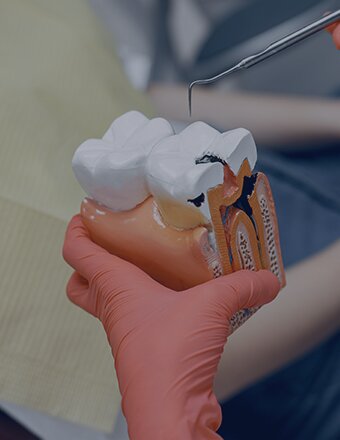
Your extraction visit, step by step
A close look first
Dr. Patel examines the tooth and takes digital X-rays. If he needs a fuller view of the roots or bone, he may use 3D cone beam imaging (a 3D scan of the teeth and jaw).
Your choices and the estimate
He explains what he found, whether the tooth can be saved, and the estimated cost and timeline before anything is done.
Getting numb
Local anesthetic numbs the tooth and the gum around it. You may notice pushing or movement. If anything feels sharp, tell us and Dr. Patel will add more anesthetic.
Taking the tooth out
A simple extraction is often quick. A surgical extraction takes longer.
Heading home
You bite on gauze to control bleeding and leave with a written aftercare guide.
Healing and aftercare
The first day
A blood clot forms in the empty socket and protects it while it heals.
- Keep gauze pressed on the site and change it as needed
- Take prescribed or over-the-counter pain medicine as directed
- Eat soft foods
- Avoid straws, smoking and forceful spitting, which can loosen the clot
The weeks that follow
- Tenderness usually settles over two to three days.
- The gum usually closes in one to two weeks.
- The bone underneath keeps rebuilding for several months.
Healing differs from person to person. Actual results may vary.
Call us if you notice
- Pain that gets worse after two or three days instead of better. This can be dry socket, which happens when the clot comes loose and leaves the bone exposed.
- Swelling that keeps growing, a fever, or a bad taste that will not go away
Go to the ER or call 911 if
- Swelling spreads toward your eye or neck
- You have trouble breathing or swallowing
- Bleeding will not stop with firm pressure
If any of these happen while we are closed, do not wait for us to open.
Replacing the tooth afterward
A gap lets neighboring teeth drift, and the jawbone where the tooth was slowly shrinks. Your main options are:
Dental implant
A small post placed in the jaw that holds a crown. About dental implants.
Dental bridge
A false tooth held in place by crowns on the teeth on each side.
Partial denture
A removable replacement that clips to your remaining teeth.
Learn more about bridges and dentures. It helps to plan the replacement before the tooth comes out.
Wisdom teeth
Wisdom teeth (third molars) usually come in between ages 16 and 25, and many mouths lack room for them, so they press on other teeth or get stuck under the gum. See wisdom teeth removal for details.
What affects the cost of an extraction
Type of extraction
A surgical extraction involves more steps than a simple one, which affects the fee.
Exam and X-rays
Needed to plan the extraction safely.
Your insurance
We welcome PPO plans and file your claims for you. What your plan pays depends on your plan, so we will help you understand your benefits. See our dental insurance page.
No insurance
Ask about the Outlook Dental Wellness Plan, our in-house membership plan.
Financing
CareCredit and Sunbit, subject to approval.
We explain the cost and your options at your visit, so you hear the estimated cost before treatment starts, not after.

Your dentist: Dr. Nishit Patel, General Dentist
Dr. Patel has practiced dentistry since 2007. He studied at Government Dental College and Hospital in Ahmedabad, India, and earned his dental degree from the University of Southern California. He completed a dental implant preceptorship at the UT School of Dentistry in San Antonio and a fellowship with Implant Pathway. He is a member of the International Congress of Oral Implantologists. He says helping people get out of pain is one of his favorite parts of the job. Meet Dr. Patel.
Tooth extraction FAQs
When is a tooth extraction necessary?
Dr. Patel first checks whether a root canal or other repair can keep the tooth. Removal makes sense when the tooth is too decayed, cracked or loose from gum disease to repair, when earlier treatment has failed, or when it crowds other teeth.
Does a tooth extraction hurt?
Local anesthetic blocks feeling in the tooth and nearby gum before Dr. Patel begins. You may notice pushing or movement, and if anything feels sharp he can add more anesthetic. Nitrous oxide is available if you feel mildly anxious, and some tenderness for a few days afterward is normal.
How long is recovery after a tooth extraction?
Expect two to three days of tenderness. The gum usually closes in one to two weeks, while the bone underneath keeps rebuilding for several months. A surgical extraction may take a little longer. Actual results may vary.
Can I have a tooth pulled the same day I call?
Call (945) 224-0070. We offer same-day appointments whenever possible, and on the phone our team decides with you whether you should come in right away or can safely wait a day or two. Whether the tooth comes out at that first visit depends on what Dr. Patel finds on the exam and X-rays.
How do I replace a tooth after it is pulled?
The usual choices are a dental implant, a dental bridge or a partial denture. Dr. Patel will explain which suits your mouth, ideally before the tooth is removed.
Visit us
Outlook Dental, 7820 W Eldorado Pkwy Suite 150, McKinney, TX 75070, near Methodist McKinney Hospital.
Call (945) 224-0070 to book your extraction visit, or send a message through our contact page. For severe pain or swelling, call right away and see our emergency dentist page.
Hours
- Monday, Wednesday, Thursday and Friday: 8:00 AM to 5:00 PM
- Many Saturdays: 8:00 AM to 2:00 PM (call ahead)
- Tuesday and Sunday: closed
Other services at Outlook Dental
What People Are Saying About Us
We have over 385+ Five Star Reviews from happy patients on Google.


